
Grants and Funded Programmes
Built Environment Transformation Gross Floor Area Incentive Scheme
Type
Productivity
Sustainability
This scheme supports private sector developments in adopting higher standards of digitalisation, productivity, and sustainability.
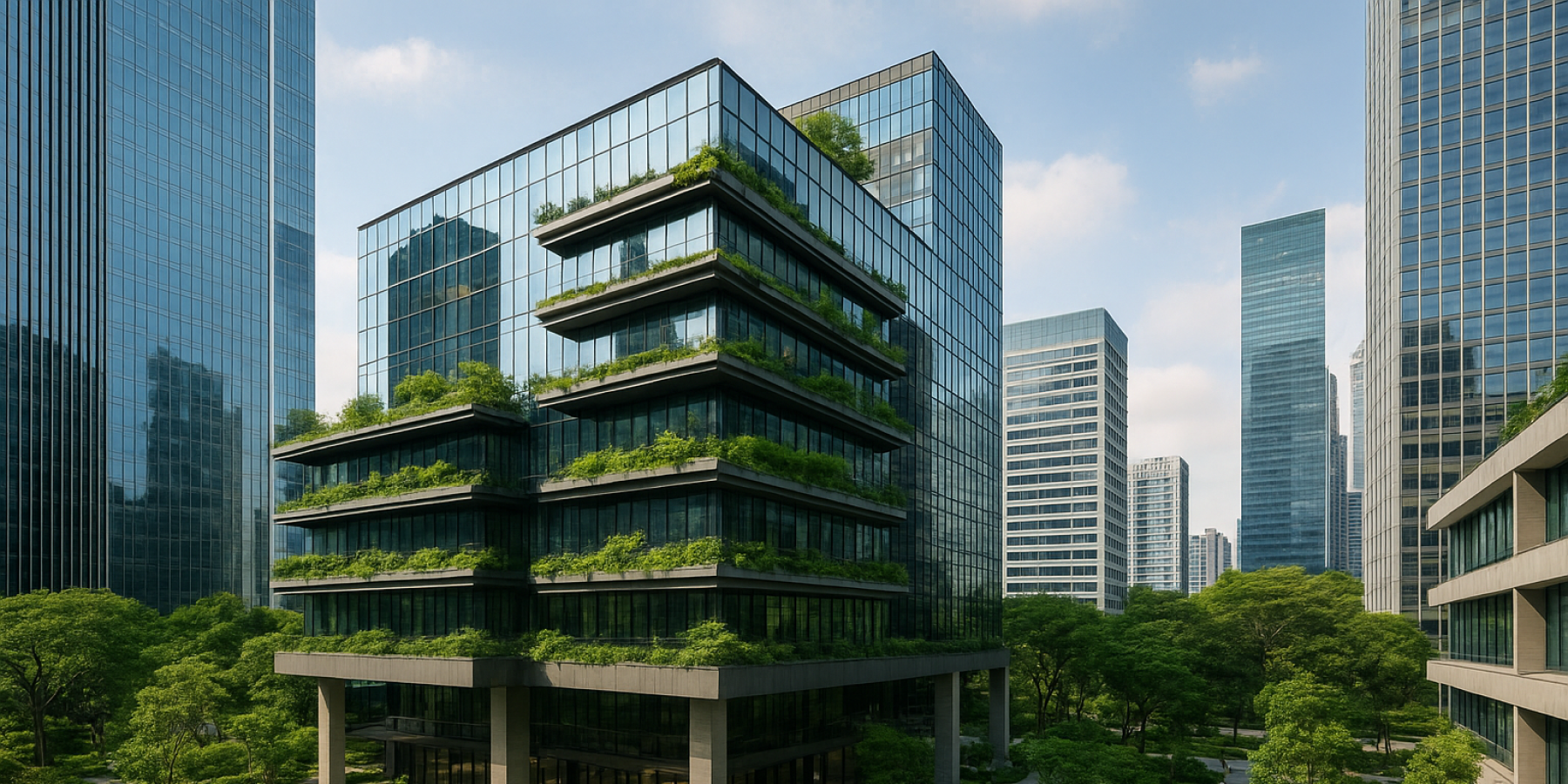
The Built Environment Transformation Gross Floor Area (BE Transformation GFA) Incentive Scheme ("Scheme") aims to encourage adoption of higher Built Environment (BE) Industry Transformation Map (ITM) standards in areas of digitalisation, productivity and sustainability ("ITM Outcome Requirements") in private sector developments.
Eligibility
The Scheme was launched on 24 November 2021 for a 5-year validity period until 23 November 2026. Under the Scheme, developers/building owners can enjoy up to 3% additional GFA allowed beyond the Master Plan Gross Plot Ratio (GPR) for delivering the stipulated ITM Outcome Requirements in their building development on private sites of at least 5,000sqm GFA [1][2]. Developments that have obtained planning approval but have not commenced superstructure works may also be eligible for the Scheme on a case-by-case basis.
The types of developments that are eligible for the Scheme are shown in the table below.
Residential[3] | Condominium and Flats developments |
Non- Residential | Commercial, Industrial and Institutional developments, such as office, retail, business parks, community building, hotel, hospital or white site developments |
Mixed use | Any combination of the above |
All Others | To be assessed based on merits of proposal |
[1] Private sites may be granted up to 3% bonus GFA under the scheme. Government Land Sales (GLS) sites are eligible up to 2% bonus GFA and is applicable for new GLS launched prior to 31 March 2022. Proposals on GLS sites that have obtained planning permission but have not commenced superstructure works may also be eligible for the Scheme on a case-by-case basis.
[2] Applications submitted under the Strategic Development Incentive (SDI) and Central Business District (CBD) incentive schemes will have to comply with stipulated outcomes in the areas of digitalisation, productivity and sustainability. The required ITM outcomes will be separately assessed in relation to the context of the proposal, upon submission of the outline application for the SDI/CBD development proposal. ITM outcomes will be imposed as conditions for planning approval for redevelopment proposals via the SDI/CBD Incentive scheme. SDI/CBDI proposals will not qualify for the additional GFA under the BE Transformation Gross Floor Area Incentive Scheme.
[3] The maximum allowable number of dwelling units for residential developments located outside of Central Area is derived from the Master Plan permissible intensity, which excludes any bonus GFA the site is eligible for.
Stipulated ITM Outcome Requirements
Applicants are to comply with BE ITM outcomes for the Scheme based on the building type.
Residential
Condominium
Flat Developments
Digitalisation
Minimum five (5) Integrated Digital Delivery (IDD) essential use cases covering three (3) stages of life cycle with at least one (1) use case per stage
Use of Common Data Environment (CDE) data standard and CDE compliant digital platform
Productivity
Minimum 65% Prefabricated Prefinished Volumetric Construction (PPVC)
Minimum 65% Prefabricated Mechanical Electrical & Plumbing (Prefab MEP) systems
Minimum 70% System Formwork
Quality Mark (QM)
OR
Requirements stipulated for developments classified under Building Type - Others
Sustainability
Green Mark (GM) Platinum Super Low Energy (SLE) with Maintainability Badge*
* exemplary performance (that is 10 out of 15 points) under the Maintainability Section in GM 2021 framework
Non-Residential
Commercial
Industrial
Institutional
Digitalisation
Minimum five (5) Integrated Digital Delivery (IDD) essential use cases covering four (4) stages of life cycle with at least one (1) use case per stage
Use of Common Data Environment (CDE) data standard and CDE compliant digital platform
Productivity
Hotel
Minimum 65% PPVC
Minimum 65% Prefab MEP systems
Minimum 70% System Formwork
Office
Structural Steel (SS) for minimum 80% of total office area
Minimum 65% Prefab MEP systems
Minimum 70% System Formwork
OR
Requirements stipulated for developments classified under Building Type - Others
Sustainability
Green Mark (GM) Platinum Super Low Energy (SLE) with Maintainability Badge*
* exemplary performance (that is 10 out of 15 points) under the Maintainability Section in GM 2021 framework
Mixed-Use Development and Others
Mixed-Use Development
Combination of the building types under Residential and Non-Residential
Others
Non-Residential development not specified above
Developments subject to review by URA's Design Advisory Panel[4]
Digitalisation
Minimum five (5) Integrated Digital Delivery (IDD) essential use cases covering
Three (3) stages of project lifecycle for private residential sites
Four (4) stages of project lifecycle for private commercial/ industrial sites
with at least one (1) use case per stage
Use of Common Data Environment (CDE) data standard and CDEcompliant digital platform
Productivity
Minimum 30% productivity improvement (compared to 2010 levels)
Minimum prefabrication levels to be adopted for the following systems:
Minimum prefabrication levels to be adopted for building systems, including structural, architectural, prefab MEP systems, and system formwork.
Structural | 65% |
Architectural | 80% |
Prefab MEP systems | 65% |
System Formwork | 70% |
Quality Mark (QM) for Residential Non-Landed component of the development.
Sustainability
GM Platinum SLE with Maintainability Badge* for the respective residential and non-residential component of the development, where relevant.
* exemplary performance (that is 10 out of 15 points) under the Maintainability Section in GM 2021 framework
[4] Excludes development proposals submitted under the Strategic Development Incentive (SDI)/Central Business District Incentive (CBDI) scheme. The required ITM outcomes for SDI/CBDI scheme development proposals will be separately assessed in relation to the context of the proposal, upon submission of the outline application for the SDI/CBDI development proposal.
Application Process and Submission Requirements
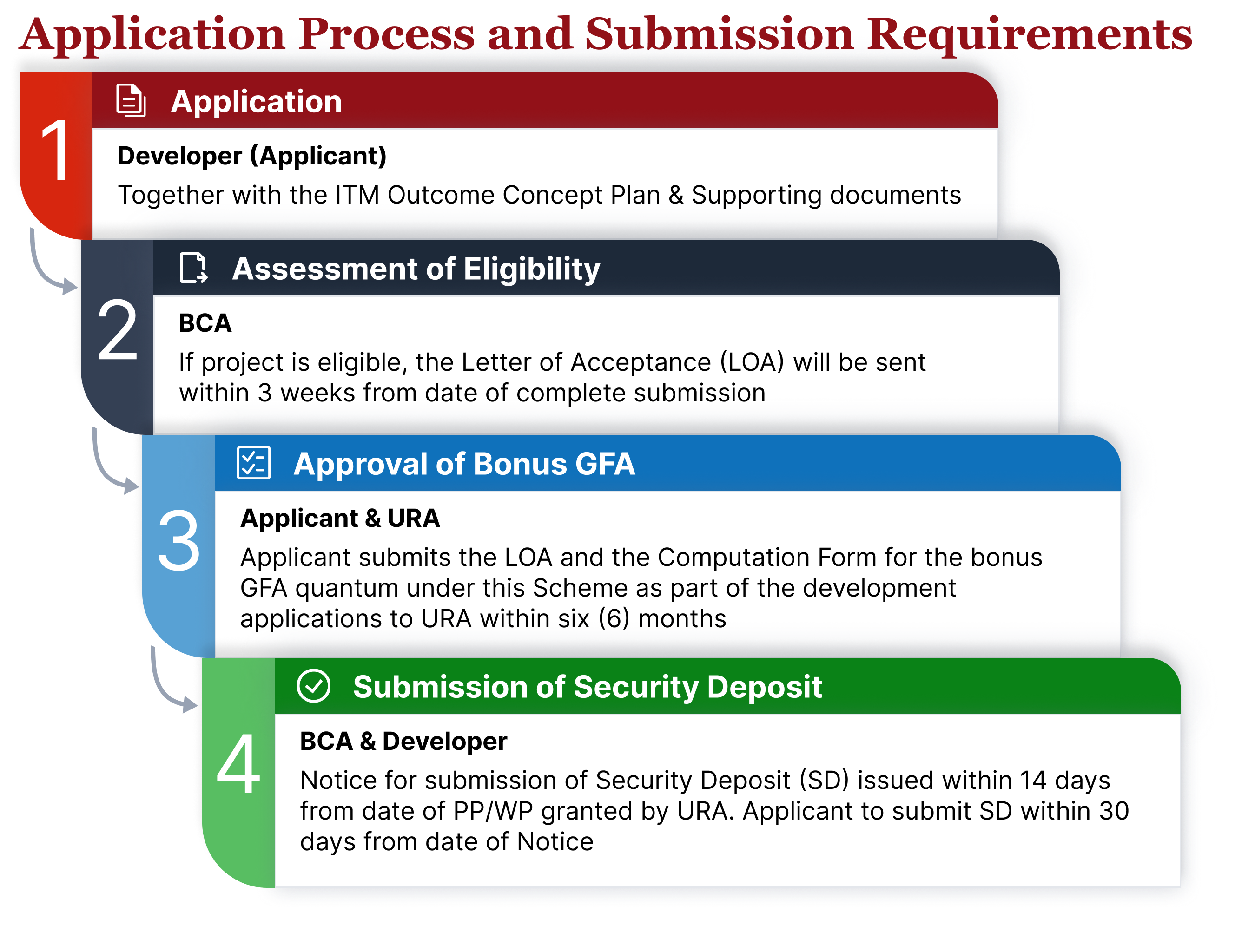
The overall detailed flowchart of the application and submission process can be found in the Submission and Evaluation Process for the BE Transformation GFA Incentive Scheme. Please refer to the form "Computation Form for BE Transformation GFA and Security Deposit" below.
Application Details
Please submit your application via FormSG
Corporate entity login is required for the form. Your Singpass ID and corporate Entity ID will be included with your form submission.
Do note that as part of the application, you will be required to submit the following supporting documents: -
Accounting & Corporate Regulatory Authority (ACRA) business profile of Applicant (Developer/Building Owner)
Only an officer listed as a Director in the business profile of the Applicant (Developer/Building Owner) (i.e. Registered Officer) can submit the Application on behalf of the Applicant. Where the officer submitting the Application is not a Registered Officer, authorisation from the Registered Officer must be granted for such officer to submit the Application on behalf of him/her. Please refer to the template "Authorisation Request Template" below.
Copy of Sales Agreement if the development is on a GLS site
Letter of Offer(s) if the development has benefitted from any incentive scheme(s) previously
Copy of Sales Agreement and PP/WP if PP/WP has been obtained for the development, where relevant
ITM Outcome Concept Plan shall outline how the project will meet the Digitalisation, Productivity and Sustainability requirements under the Scheme and shall include the following: -
site layout plans and other drawings
a Productivity Implementation Plan
an IDD Implementation Strategy
a Green Building Concept Plan
Please refer to the template "ITM Outcome Concept Plan Template" below.
Specific Deliverables and Reporting Requirements
As the Scheme is tied to ITM outcomes that involve improvements to the design and construction process of new developments, evidence of compliance with the stipulated ITM Outcome Requirements and timeline during the construction phase will be important. As such, the submission of half-yearly progress reports to BCA during the construction life cycle by the applicant will be required. The following chart summarises the specific deliverables and reporting requirement.
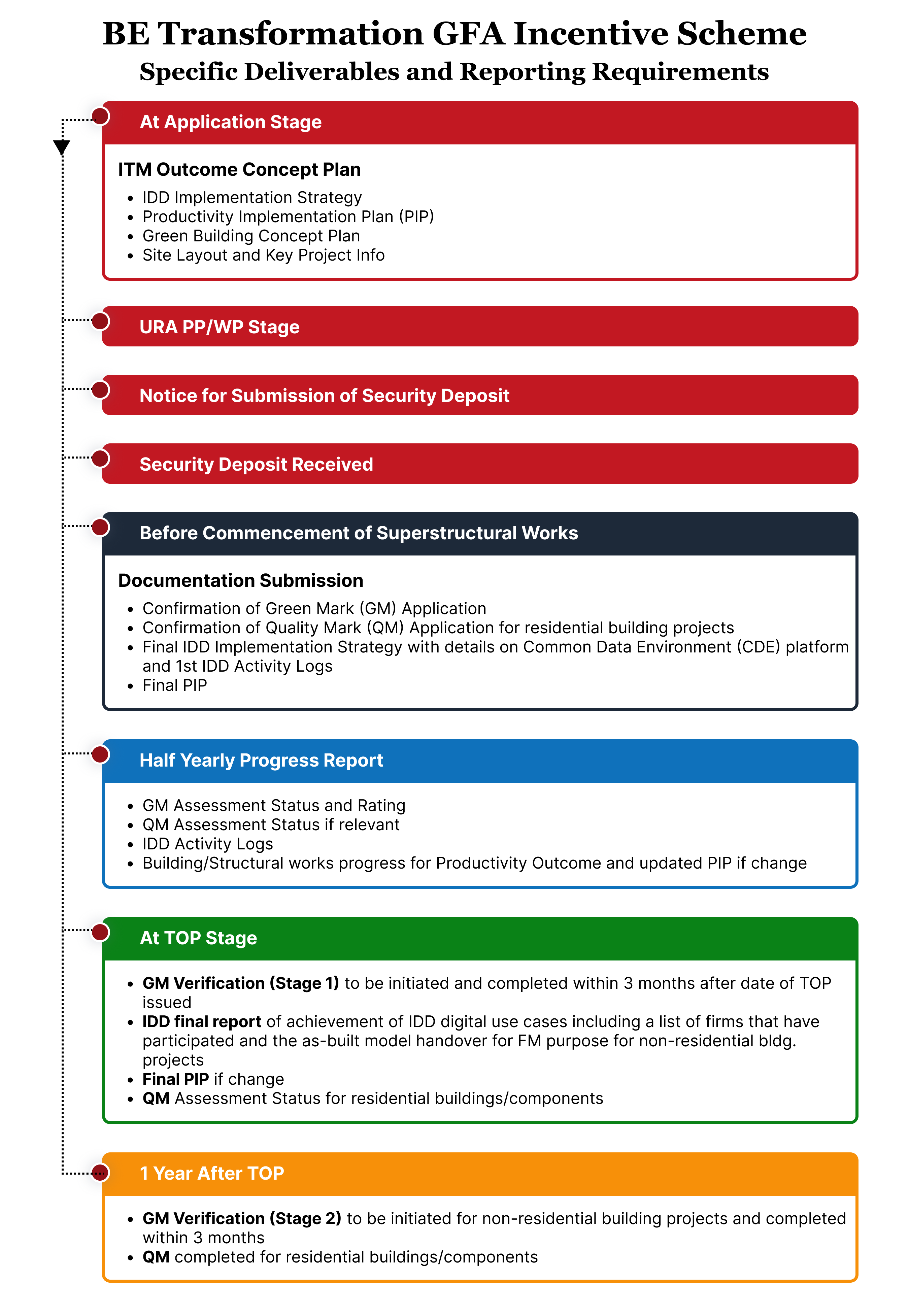
Please refer to the document "ITM Outcome Deliverables and Reporting Requirements" below for more details. Please also refer to the "Progress Report Template" below.
Relevant documents and templates
For application:
For reporting: