
Alternative Entry Pathway (AEP) Programme
The AEP programme empowers firms to take greater ownership over the recruitment process for new Construction Work Permit holders (WPHs) by allowing firms to directly bring in skilled new WPHs into Singapore, resulting in better quality new WPHs and a greater job-skills match for new WPHs. Want to participate in AEP? Explore what is available and the application requirements.
Last updated on 6 November 2026

The alternative pathways encourage employers to take ownership of the recruitment process and ensure workers are well-matched to specific job requirements and trade specialisations.
Alternative Entry Pathway (AEP)
What is it?
The AEP programme allows responsible and progressive firms to take greater ownership in identifying and selecting better quality new Construction WPHs. Firms can propose recruitment pathways to directly bring in workers who have relevant experience in specific trades or undergone customised training or possess vocational certifications.
What pathways are available to the industry under AEP?
The following pathways are supported under the AEP programme –
1. Vocational Certification: Firms can bring in new Construction WPHs who possess vocational certification offered by vocational institutions recognised by source country governments.
2. Employer-led Process: Firms can submit a proposal on a process to select and bring in better quality new Construction WPHs. This could include a robust selection process at source that includes interviews, practical skills assessments, or screening for criteria such as previous experience in relevant trades. Firms can also propose an in-house training plan for new workers to be skilfully deployed upon arrival in Singapore.
Key benefits of AEP:
Greater flexibility to bring in better quality new Construction workers via employer-led processes, where firms have more ownership and responsibility over recruitment pathways not limited to only practical skills assessments
Better match between the trade that the new Construction WPH has experience in and is assessed in Singapore and eventually deployed to
Shorter time needed to bring in new Construction workers, as WPHs brought in via AEP need not undergo pre-entry SEC(K) testing at source but can take the SEC(K) in Singapore.
How does it work?
BCA has worked with the Ministry of Manpower (MOM) ↗(opens in new tab) (opens in new tab) to allow new Construction workers to enter Singapore without SEC(K) obtained at the source countries under AEP pilot. AEP pilot proposals that perform well and demonstrate ability to bring in better quality new Construction workers during the pilot stage could be mainstreamed.
New Construction WPHs who enter via mainstreamed AEP pathways will not be required to obtain SEC(K) overseas or locally.
The following parameters apply for approved AEP pilot proposals:
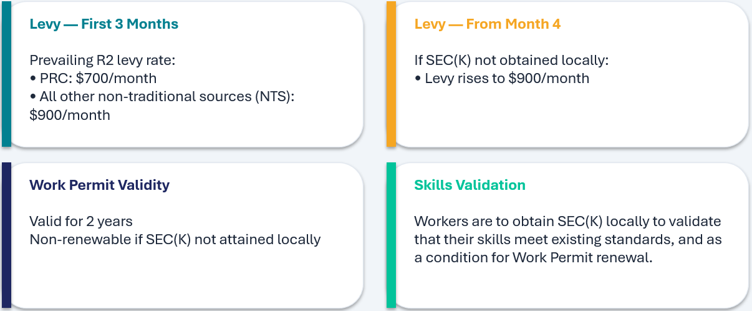
Firms that wish to tap on AEP to bring in new Construction WPHs must submit a proposal to BCA to pilot either the Vocational Certification or Employer-led Process pathway, demonstrating how they intend to select and train better quality workers in specific trades.
Navigating AEP for PRC & Thailand Construction WPHs from 1 January 2027
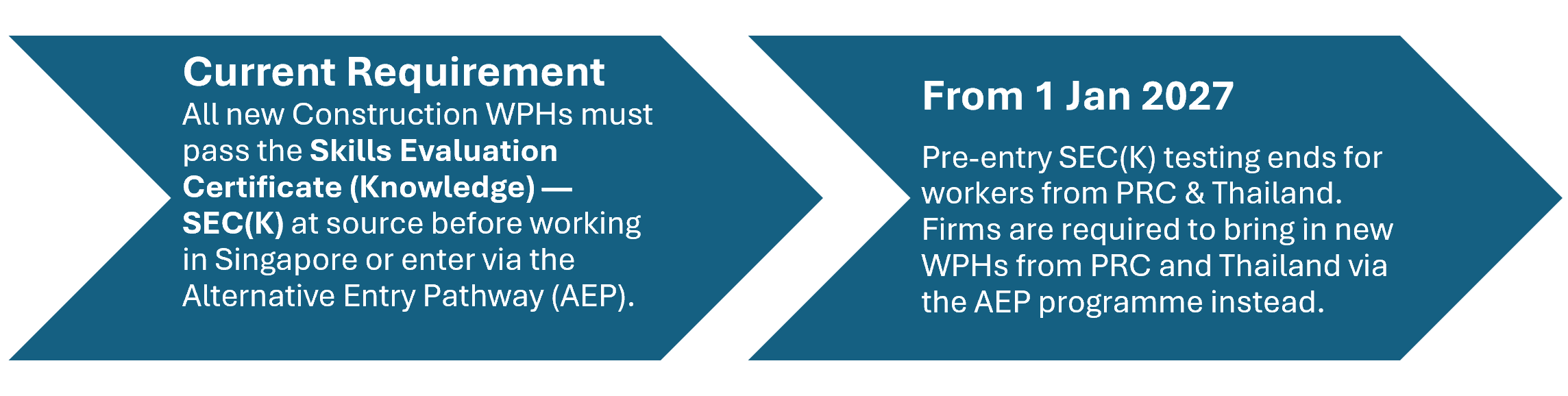
Under the AEP (Mainstreamed) route, BCA has recognised nine vocational certifications across six trades currently offered in PRC and Thailand. As these certifications have been assessed to be on par with existing SEC(K) standards, new workers from PRC and Thailand holding a recognised vocational certification can work in Singapore without needing to obtain SEC(K) locally from 1 January 2027.
Where a recognised vocational certification is assessed to be on par with passing SEC(K) at the higher-skill level, the worker is eligible for the Direct R1 pathway and this qualifies them for R1 (Higher-skilled) status if they earn a minimum fixed monthly salary of $1,600. The list of vocational certifications recognised by BCA under AEP and deemed equivalent to attaining SEC(K) level is tabulated below:
Table caption
S/N | Vocational Centres in PRC and Thailand | Contact Information | S/N | Vocational Certification Trades recognised by BCA under AEP | Eligibility for Direct R1 pathway |
1 | Nanjing Technical Vocational College & Nanjing Test Centre | ginasng@chinaconstruction.com.sg | 1 | Electrical Wiring Installation | ✓ |
2 | Timber Formwork^ | ✓ | |||
3 | Steel Reinforcement Work | ✓ | |||
4 | Plastering | ✓ | |||
5 | Tiling | ✓ | |||
2 | Shenyang Nanyang Vocational and Technical Training School | 6 | Timber Formwork^ | ✓ | |
7 | Plastering | ✓ | |||
8 | Tiling | ✓ | |||
3 | Chiangmai Skill Development School and Languages | 9 | Aluminium Formwork^ | ✓ |
^ All formwork workers under the AEP scheme are required to pass the WSQ: Perform Formwork Activities (formerly known as Formwork Safety Course for Workers) conducted by MOM's Accredited Training Providers before commencing work on site, in accordance with the WSH (Construction) Regulations.
For firms intending to bring in new Construction WPHs from PRC and Thailand with vocational certification recognised by BCA the process is as follows:
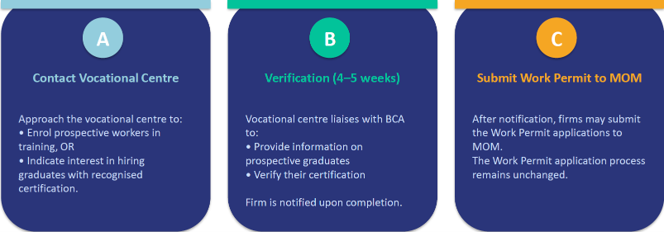
To ensure that the recognised vocational certifications remain on par with existing skills standards, BCA may conduct sample audits.
Alternatively, firms that wish to source for new Construction WPHs from PRC and Thailand beyond the BCA-recognised vocational certification can also submit a proposal to BCA to pilot their own Employer-led Process pathway.
Next steps for Built Environment Firms
These programmes represent BCA's commitment to support firms in accessing skilled foreign manpower whilst maintaining standards. The AEP programme enables firms to take greater ownership over the recruitment process for new Construction WPHs, to bring in better quality new WPHs and a greater job-skills match for new WPHs.
Ready to participate?
Firms can directly submit an AEP pilot proposal ↗(opens in new tab) (opens in new tab) to BCA if they are interested in embarking on an AEP pilot in any of the pathways.
| Update | Application for India AEP
The application period for this round of India AEP has closed on 30 October 2026. Thank you for submitting your AEP applications to BCA for consideration. We are reviewing the applications received and will inform applicants of the outcome in due course. Meanwhile, you may continue to submit AEP applications to bring in skilled and experienced workers for other source countries via https://go.gov.sg/bca-aep-bcl (opens in new tab)
Alternatively, there are several organisations running AEP pilots, including Trade Associations & Chambers (TACs) and Non-Government Organisations (NGOs). Firms may approach them to tap on existing AEP pilots to bring in new Construction WPHs.
Table caption
Entity involved | Link |
Asia Philanthropy Circle (APC) | https://asiaphilanthropycircle.org/migrant-worker-sandbox/ (opens in new tab) ↗(opens in new tab) (opens in new tab) |
Micro Builders Association Singapore (MBAS) | https://mbas.org.sg/programmes-resources/manpowering-office/ ↗(opens in new tab) (opens in new tab) |
To find out more about foreign Construction manpower access, visit our Foreign Manpower Access page ↗(opens in new tab) (opens in new tab).
Additional resources
Learn more about other foreign manpower programmes available to Built Environment firms:
For questions about any of these programmes, contact BCA through our feedback form (opens in new tab) or call our hotline.