
Accreditation Framework for Built Environment professionals
Discover BCA's Accreditation Framework supporting competency-based recognition of Built Environment professionals through standardised schemes and procurement practices.
Last updated 27 January 2026
What is the Accreditation Framework for Built Environment professionals?
The Skills Framework for the Built Environment (BE Skills Framework) aims to drive the upskilling and recognition of Built Environment (BE) professionals through partnership with key stakeholders – BE professionals, employers and service providers.
To support the BE Skills Framework, the Accreditation Framework for Built Environment Professionals adopts a standardised approach to validate and recognise BE professionals’ competencies and skillsets.
What does the Accreditation Framework cover?
Accreditation schemes for various BE career tracks
BCA has worked closely with the Trade Associations and Chambers (TAC) to co-develop the pathways and skills for the BE career tracks. The Accreditation Schemes cover career tracks that includes Project Management, Engineering Consultancy & Design, Quantity Surveying, Construction Management, Digital Delivery Management and Facilities Management.
Verification by an industry panel
A panel comprising representatives from key service buyers reviews the accreditation schemes developed by the Accreditation Bodies.
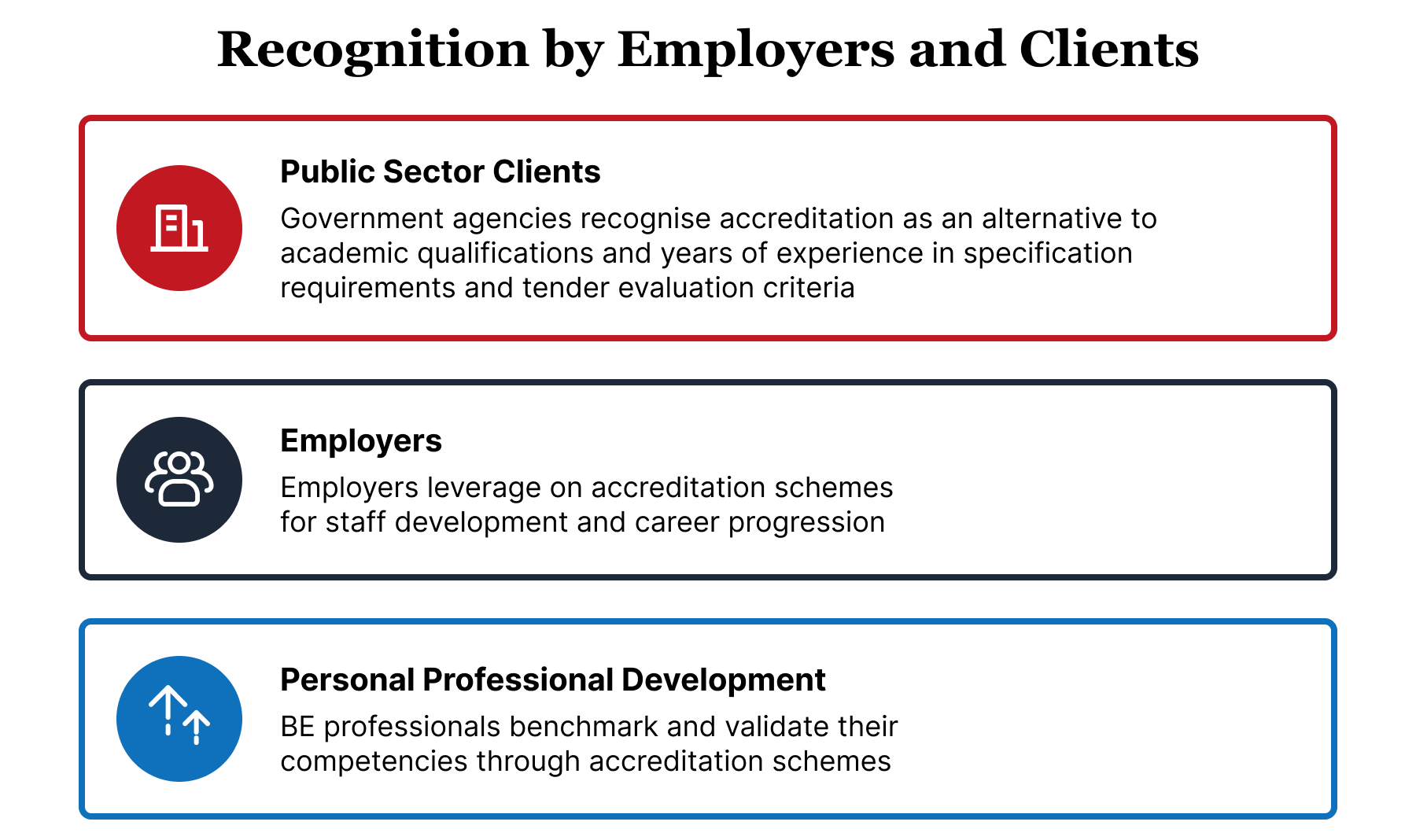
Recognition by employers and clients
Public sector clients: Government agencies recognise accreditation as an alternative to academic qualifications and years of experience in specification requirements and tender evaluation criteria.
Employers: Employers leverage on accreditation schemes for staff development and career progression.
Personal professional development: BE professionals benchmark and validate their competencies through accreditation schemes.
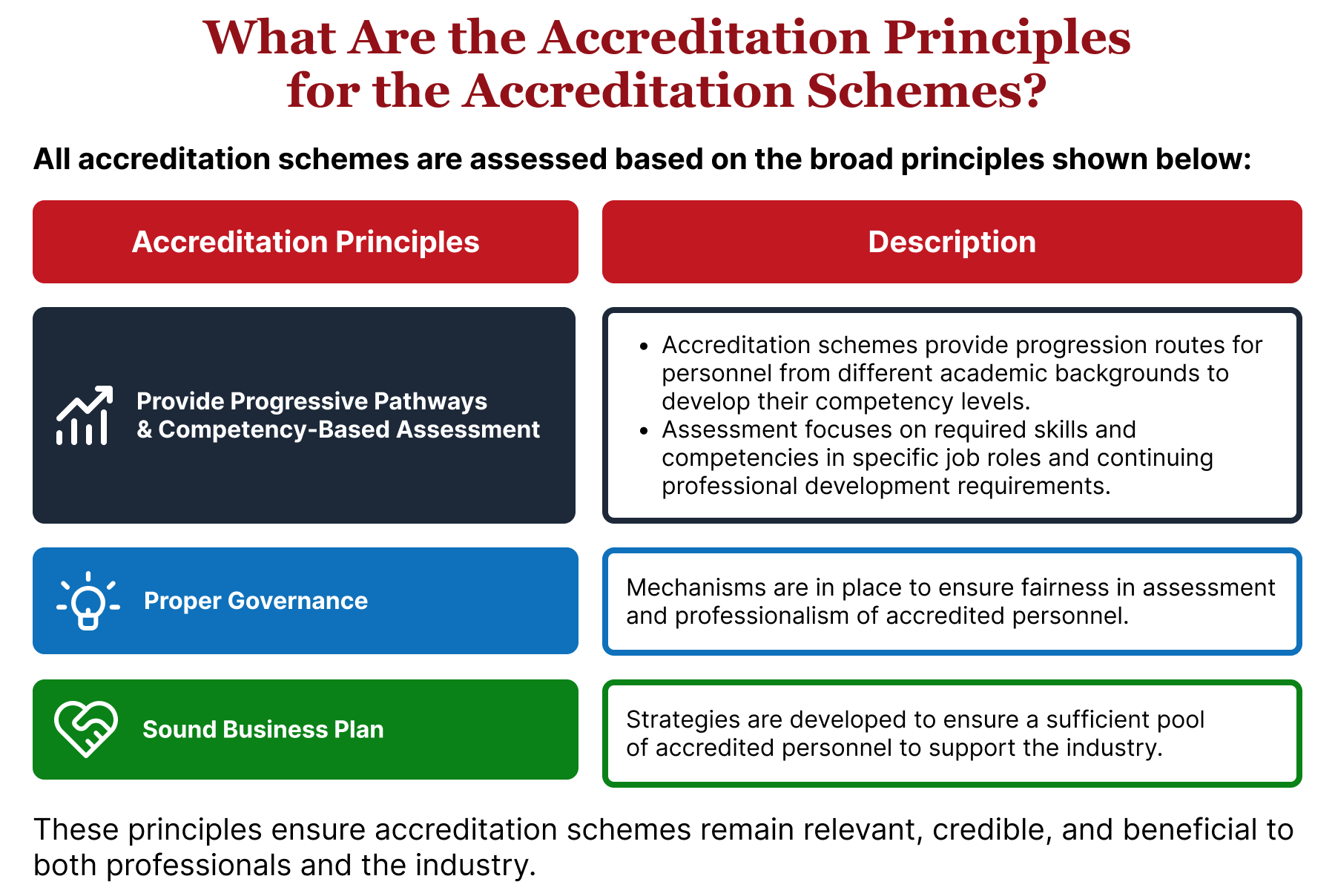
What are the Accreditation Principles for the accreditation schemes?
All accreditation schemes are assessed based on the broad principles shown below:
Principles of accreditation schemes
Accreditation Principle | Description |
Provide progressive pathways & competency-based assessment |
|
Proper governance | Mechanisms are in place to ensure fairness in assessment and professionalism of accredited personnel. |
Sound business plan | Strategies are developed to ensure a sufficient pool of accredited personnel to support the industry. |
These principles ensure accreditation schemes remain relevant, credible, and beneficial to both professionals and the industry.
How is the framework being implemented in public sector procurement?
Government agencies recognise accreditation as an alternative to academic qualifications and years of experience in specification requirements and tender evaluation criteria.
Examples of procurement specifications using accredited personnel are available in BCA's circular on the Accreditation Framework.
BCA also accepts accreditation as an alternative to academic qualifications under the Contractor Registration System (CRS) and Public Sector Panels of Consultants (PSPC).
Which accreditation schemes are available?
The following accreditation bodies are currently administering accreditation schemes related to BE professions:
Accreditation bodies currently administering accreditation schemes
Career Track | Accrediting Body |
|---|---|
Construction Management | |
Digital Delivery Management | |
Engineering Consultancy and Design | |
Facilities Management | |
Project Management | |
Quantity Surveying |
Additional resources and support
Skills Framework for Built Environment - Comprehensive skills development framework for BE professionals
Contractors Registration System (CRS) - Registration requirements for construction contractors
Public Sector Panels of Consultants (PSPC) - Consultant registration and requirements