
Collaborative Contracting
Discover collaborative contracting approach that strengthens mutual trust, enables early risk identification, and enhances project delivery through teamwork and cooperation in construction projects.
Last updated 29 March 2026
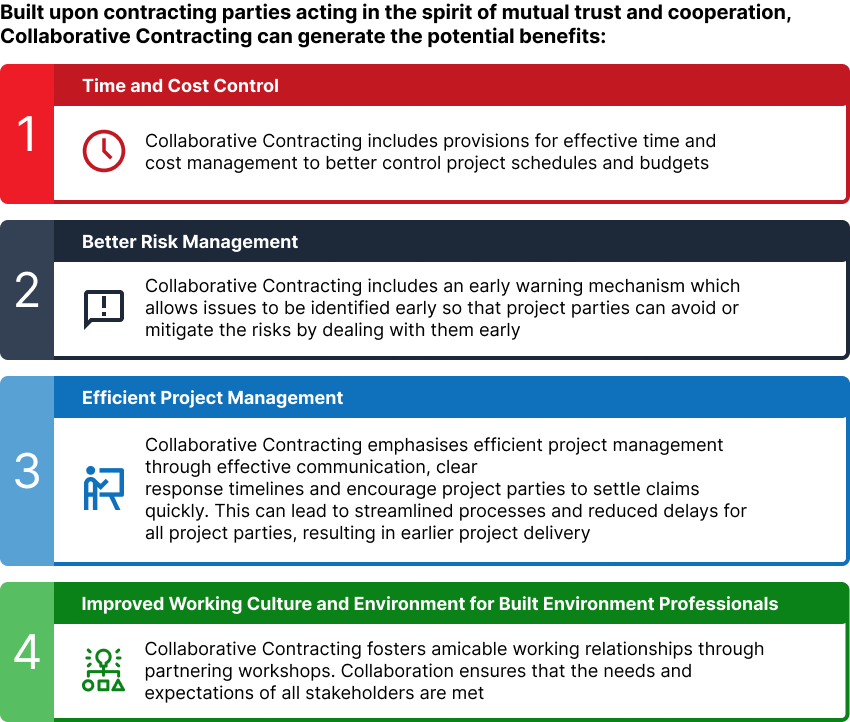
Collaborative contracting seeks to overcome the issues in traditional contracting. It encourages a mindset shift towards working collaboratively for shared project goals and helps parties to proactively identify and resolve potential issues early. It also provides a framework to better manage disruptions and project delivery. To achieve these outcomes, it draws upon a number of common elements, such as risk sharing, open communication, and joint problem solving.
What is Collaborative Contracting?
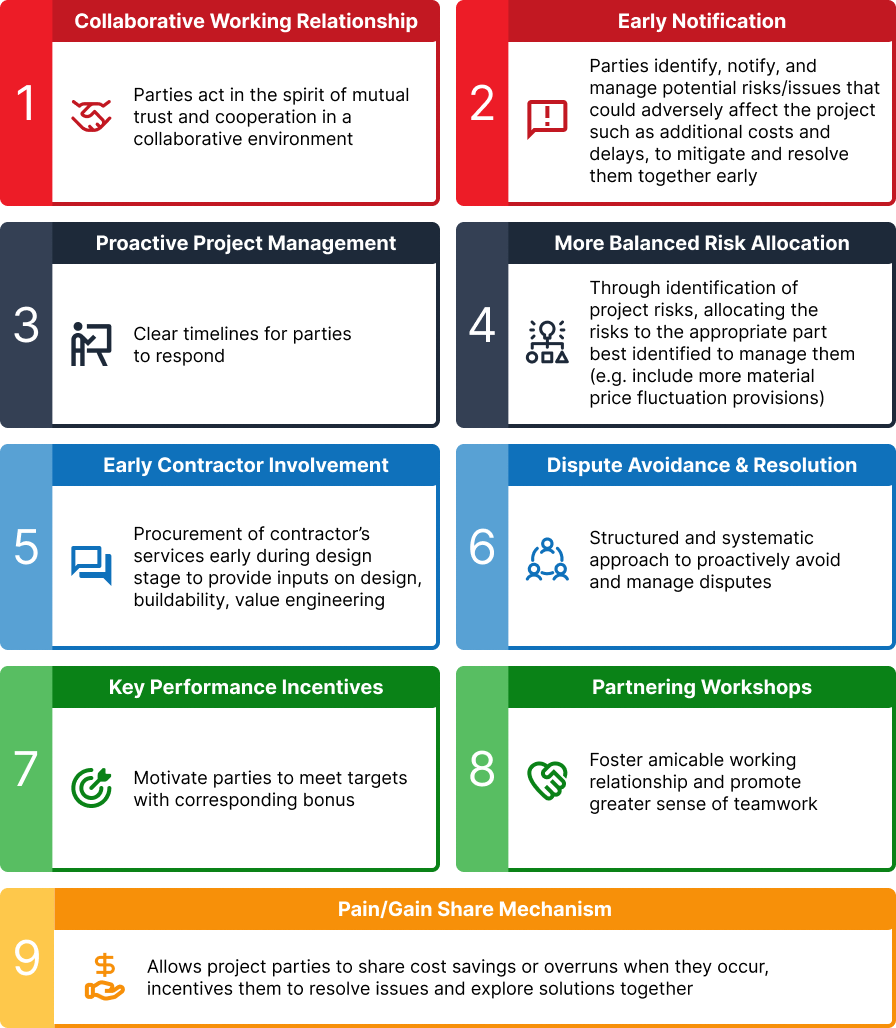
Collaborative contracting works through specific contract clauses and processes that change how teams partner for the success of a construction project. These include the following key features found in the infographic below.
Key features of Collaborative Contracting
Benefits of Collaborative Contracting
Collaborative Contracts
BCA has been facilitating adoption of collaborative contracting through the following efforts:
Option Module on Collaborative Contracting
The first is an Option Module on Collaborative Contracting for use with Public Sector Standard Conditions of Contract (PSSCOC) to ease adoption for public sector projects. The Option Module incorporates six key collaborative contracting principles:
Collaborative working relationship for parties to act in spirit of mutual trust and cooperation
Partnering workshops to foster amicable working relationship and promote greater sense of teamwork
Structured dispute avoidance and resolution mechanism with involvement of independent third party to proactively avoid and manage disputes
Early notification to identify risks early, mitigate and resolve issues together
Proactive project management through clear timelines for parties to respond and settle claims timely
Key performance incentives to motivate contractor to meet targets beyond the contract scope
Adapting NEC4 for use in Singapore
The second is adapting an international contract form, NEC4, for use in Singapore. NEC4 is designed to facilitate and encourage good management of risks through mutual trust and cooperation of project parties. NEC contracts are drafted around three principal objectives:
Flexibility – enable the contract to be customised to suit different project needs through its modular structure and optional clauses
Clarity – written in plain English avoiding legal terminology
Stimulus to good project management – incorporate the principles of good project management requiring parties to adhere to processes designed to manage time, cost and quality
Unlike traditional contracts that stipulate lump sum payments, the NEC4 contract form provides an option for a target cost approach. This allows project parties to share cost savings or overruns when they occur and incentivises them to work together to not only resolve issues but explore new methods and innovations.
BCA has developed additional clauses to better support the implementation of NEC4 ECC1 and FMC2 pilot projects in Singapore.
For more information on NEC4 contract, please visit NEC Contract website.
1 The NEC4 Engineering and Construction Contract (ECC) is the main works contract for construction and engineering projects in the NEC4 suite of collaborative contracts for built environment procurement. Selected public and private sector projects in Singapore are piloting the use of NEC4 ECC.
2 The NEC4 Facilities Management Contract (FMC) is used for the appointment of a service provider for a period of time to manage and provide a facility management service.
Steps to initiate Collaborative Contracting
Adopt a collaborative contracting approach: Adopt collaborative contractual provisions, the PSSCOC Option Module on Collaborative Contracting or NEC4 contract form.
Obtain training and develop capabilities: Equip team members with a good understanding of Collaborative Contracting provisions and principles. To support industry adoption, training programmes are available through multiple providers including BCA Academy, Institutes of Higher Learning and industry associations.
Partnering with experts: Engage professionals who are experienced in Collaborative Contracting to provide advisory services to guide the team through implementation in the early phases.
Consider early contractor involvement: De-risk complex projects by engaging contractors early in the project. This helps all parties benefit from their expertise and input during the planning and design stages. Users may consider adopting one of BCA’s Early Contractor Involvement (ECI) models.
Additional resources
The Singapore Infrastructure Dispute-Management Protocol (SIDP) referenced in the Option Module on Collaborative Contracting can be found in:
Singapore Infrastructure Dispute-Management Protocol (SIDP);
Singapore International Mediation Centre (SIMC) Dispute Boards; and
To purchase NEC4 ECC forms and access additional guidance materials, visit the NEC Contract website.
For more information on public sector procurement frameworks, explore the Public Sector Standard Conditions of Contract (PSSCOC) page.
Contact Information
For specific enquiries about implementing collaborative contracting in your projects, contact BCA's Procurement Policy Department through the BCA website.