
Past Events
Flattening the COVID-19 curve with green buildings and sustainable development
20 June 2020
By BCA
The COVID-19 pandemic has highlighted the issue of overconsumption by society and the impact of construction on the environment, concerns that have spurred the industry to focus more efforts to build sustainably to positively impact the well-being and health of the community.— BCA
The COVID-19 pandemic has hit Singapore construction industry hard. However, the health crisis has also spurred the industry to find ways to deal with the spread of the virus within buildings, including designing sustainably.
On 4 May 2020, two industry practitioners shared their insights on lessons learnt from the pandemic and strategies on heightening community resilience through environmental sustainability in the first segment of a three-day webinar attended by more than 2,300 industry professionals. The webinar was organised by the Building and Construction Authority (BCA), in partnership with the Singapore Institute of Architects (SIA) and Association of Consulting Engineers Singapore (ACES).
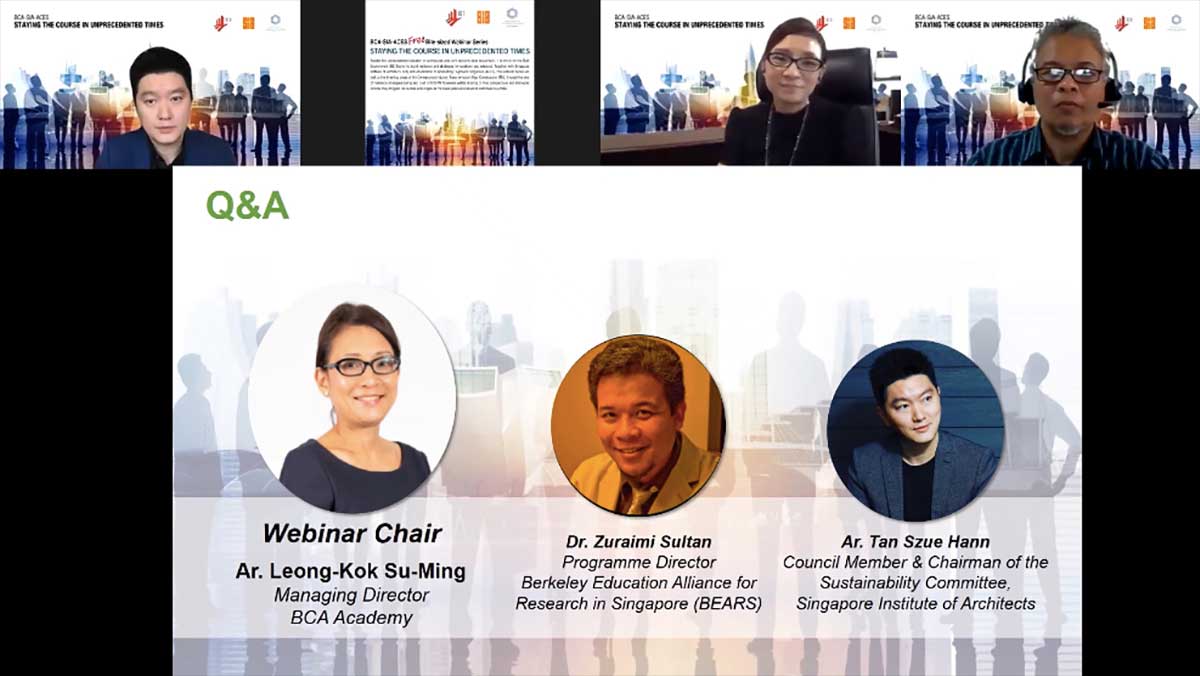
Industry experts Dr Zuraimi Sultan and Ar Tan Szue Hann discussed how green buildings and sustainable development can help flatten the curve during the COVID-19 pandemic.
Shaping the future with green buildings
According to Dr Zuraimi Sultan, Programme Director, Berkeley Education Alliance for Research in Singapore (BEARS), strategies to improve air quality in buildings have a big role to play in stemming the spread of the coronavirus.
The World Health Organisation (WHO) has said the COVID-19 virus is primarily transmitted via droplets, whether amongst individuals in close contact or via surfaces that carry the droplets. However, it is worthwhile for the community to consider putting in place measures that make for greener buildings, as improved air quality not only reduces the risk of the spread of the COVID-19 virus, but also enhances overall health and well-being of its occupants.
Dr Zuraimi cited a paper by the Singapore Berkeley Building Efficiency and Sustainability in the Tropics (SinBerBEST) that focuses on recommendations for air conditioning and mechanical ventilation in commercial and residential buildings.
Among the recommendations shared were for occupants of naturally ventilated buildings such as HDB flats and other spaces to minimise the use of air conditioning as much as possible. Using fans and keeping windows open helps to improve ventilation.
Building owners and facilities managers can also place portable air cleaners in selected rooms. They should remember to keep exhaust systems of washrooms switched on 24/7 to reduce the risk of fecal-oral transmission. Lastly, wherever possible, modify placement of work stations in a staggered layout, taking into consideration the role of air flow in transmission of the COVID-19 virus.
Seven guidelines to design and build sustainably
The COVID-19 pandemic has also highlighted the issue of overconsumption by society and the impact of construction on the environment, concerns that have spurred the industry to focus more efforts to build sustainably to positively impact the well-being and health of the community, said Ar Tan Szue Hann, Council Member and Chairman of the Sustainability Committee, Singapore Institute of Architects (SIA).
Ar Tan shared that SIA has developed seven guidelines on how buildings can be sustainable. These goals are guided by the United Nations sustainable development goals.
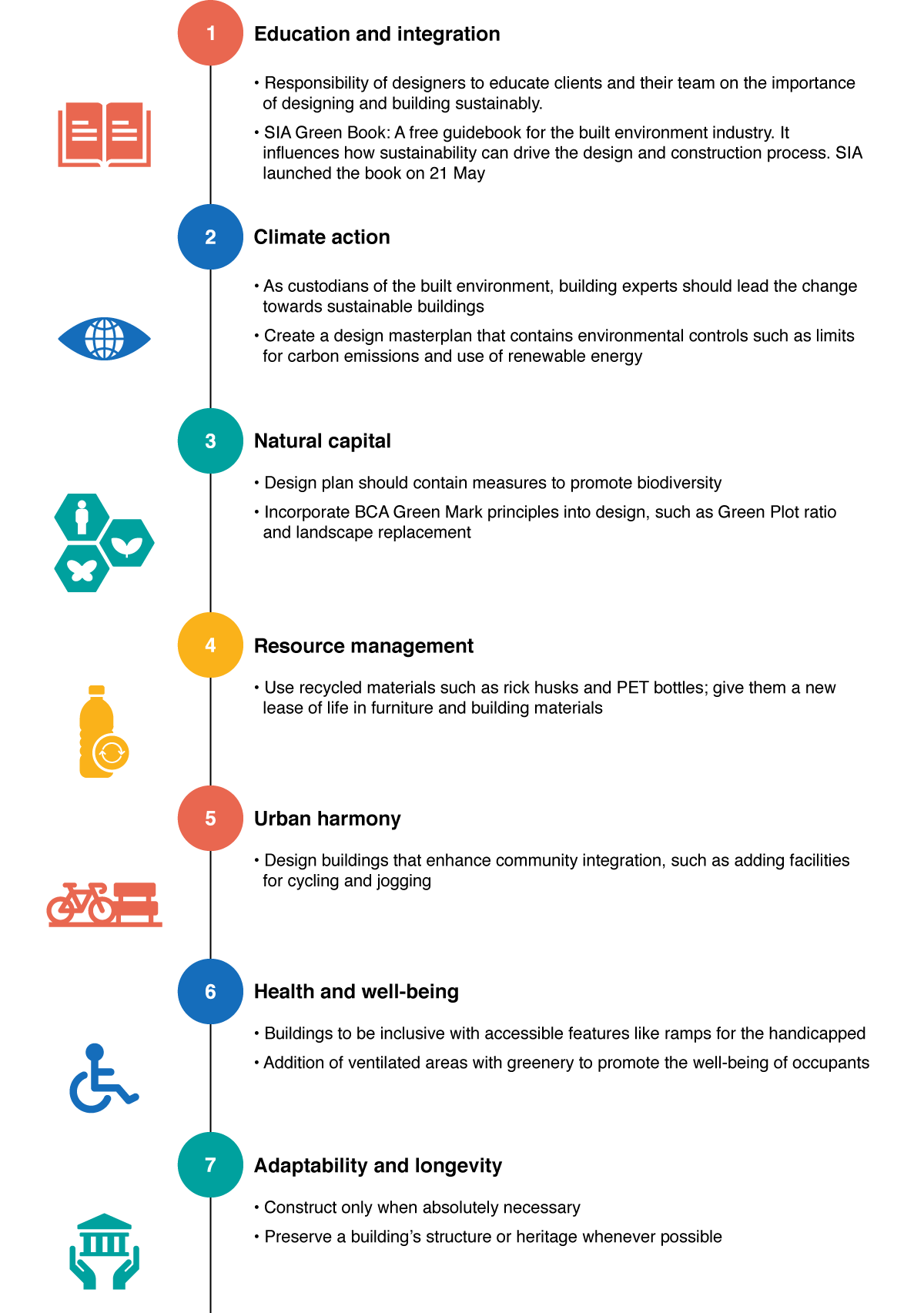
Ar Tan added that designers should extend the seven goals across a project’s timeline and the building’s life cycle to achieve meaningful impact on sustainability. In view of COVID-19, designers should rethink building typology that helps people deal with pandemic times in the future. For instance, ventilation should be top of mind and building designs should be expandable, to allow for spaces that could double up for disease containment.
About the speakers
Dr Zuraimi Sultan is a Programme Director at BEARS and SinBerBEST programme. SinBerBEST is an interdisciplinary group of researchers from UC Berkeley, Nanyang Technological University (NTU), National University of Singapore (NUS), Singapore University of Technology and Design (SUTD) and Singapore Institute of Technology (SIT).
Ar Tan Szue Hann is a Council Member and Chairman of the Sustainability Committee, SIA. He is also an award-winning architect and a thought leader in sustainability.