
Past Events
Opportunities in a crisis
4 June 2020
By BCA
The effects of the Covid-19 pandemic situation has been undisputedly dire and disruptive across all industries. But there are always opportunities in a crisis. All that remains is for companies to look for them and seize them.— BCA
As the Covid-19 pandemic ravages the health of economies around the world in 2020, one of the hardest hit sectors in Singapore is the built environment sector. Strict border controls, disruption in supply chains and a sudden halt in construction activity has dealt a triple blow to the processes that used to operate almost seamlessly within the industry.
In the second session of BCA-SIA-ACES Webinar Series, industry experts Mr Khor Yew Chai, Director (PPVC) of Dragages Singapore and Mr Ramamoorthy Rajendran, Managing Partner of Arth Design Build, were invited to share on their companies’ resilience strategies to facilitate Design for Manufacturing and Assembly (DfMA) business continuity during the current pandemic situation.
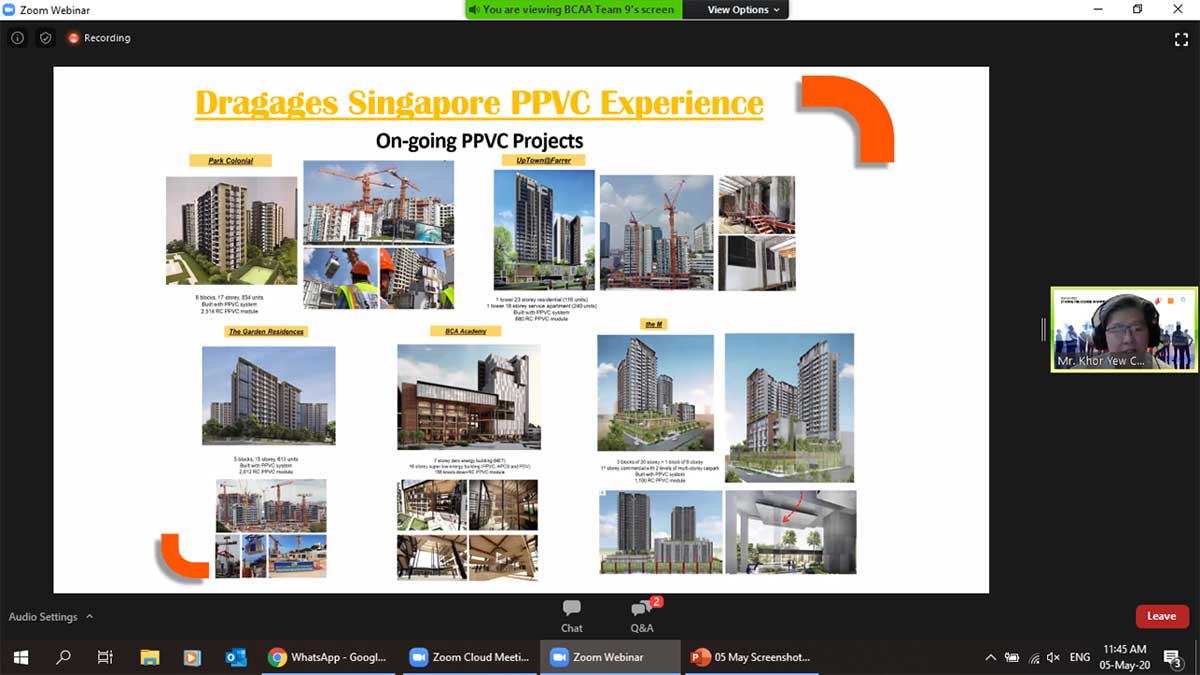
Mr Khor Yew Chai of Dragages Singapore sharing the company’s experience with PPVC projects at the webinar.
Managing risks through a nimble DfMA approach
A DfMA approach focuses on the ease of manufacture and efficiency of assembly by simplifying the design of a product. In construction, it allows building projects to be completed quickly, efficiently and at a lower cost. Prefabricated and prefinished volumetric construction (PPVC) technology is used to prefabricate modules offsite in a factory. These freestanding modules are then sent to a separate factory to be fitted out with finishes for walls, floors, and ceilings before being assembled on site.
By splitting the manufacturing and assembly process into three components – production, fitting out and installation, DfMA allows work to happen at separate sites at the same time. Greater time and resource savings are achieved compared to more traditional on-site manufacturing processes.
During pandemic periods, the simultaneous, off-site nature of DfMA confers additional advantages. Using Dragages’ experience as an example, Mr Khor pointed out that the natural segregation and flexibility of DfMA processes allow for safe distancing practices to be easily and quickly put in place. Workers can be split into shifts, and with smaller groups of workers at separate sites, infection risk is reduced.
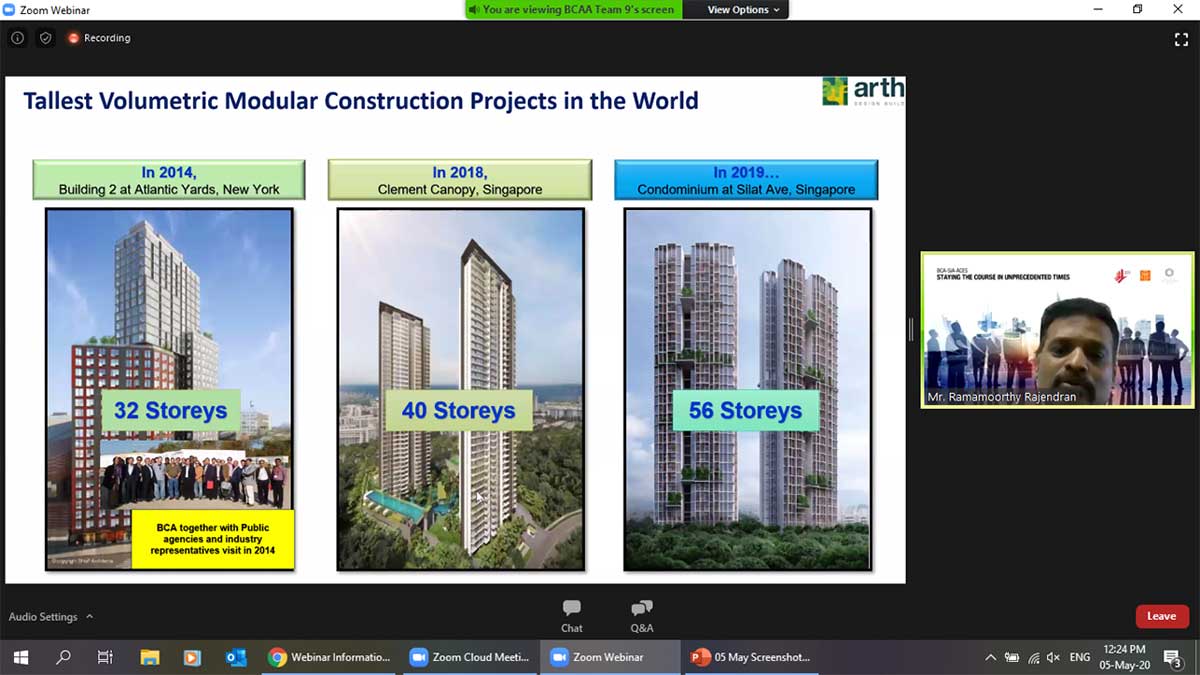
Mr Rajendran of Arth Design Build discussed the efficacy of using DfMA for volumetric construction and modular building.
DfMA is the future of construction
Additionally, Mr Rajendran of Arth Design Build alluded to the fact that efficiency through adoption of DfMA processes can be easily facilitated by technologies and digital tools to support its workflow. For example, the entire DfMA workflow can be tracked and managed by a Digital Management Platform. This allows all stages – from design and planning to fabrication and installation – to be monitored remotely; a boon for stakeholders compelled to work from home in a lockdown situation.
In other words, by leveraging technologies, architects and engineers do not need to be on site all the time or be involved in frequent face-to-face meetings to advance a building project.
Addressing the issue of labour scarcity and productivity during a pandemic, Mr Rajendran broached the possibility of introducing robots and 3D printing into the construction process. A good case in point is the recent collaboration by Nanyang Technological University (NTU) and Sembcorp in an experimental initiative to produce 3D-printed prefabricated bathroom units.
DfMA opportunities beyond Singapore
BCA is aiming for an eventual DfMA market adoption rate of 70% of construction projects in Singapore by 2025. There is also a growing showcase of these projects here, such as the newly-completed The Clement Canopy, billed as the world’s tallest modular building.
The quick adoption rate of DfMA processes by Singapore construction firms spell opportunities for local players to export their capabilities beyond our shores.
The effects of the Covid-19 pandemic situation has been undisputedly dire and disruptive across all industries. But there are always opportunities in a crisis, as Mr Rajendran reminds us in his closing remarks. All that remains is for companies to look for them and seize them.
About the speakers
Mr Khor Yew Chai is the Director (PPVC) of Dragages Singapore with more than 30 years of construction experience in Singapore.
Mr Ramamoorthy Rajendran is a Managing Partner of Arth Design Build. He is a Chartered Professional Engineer (Engineers Australia) with 20 years of experience in the Singapore construction industry.