
Inter-Agency Coordinating Committee (IACC)
The Inter-Agency Coordinating Committee is a coordinating body to help businesses navigate around regulatory requirements.
Last updated 16 March 2026
Background
IACC is a tripartite committee comprising all regulatory agencies, key industry associations and key public sector developers in the built environment. It was formed in July 2011 as a platform to facilitate resolution of issues related to conflicting or contesting regulatory requirements amongst different agencies encountered by project parties in their construction projects.
IACC also serves as a centralised coordinating body to enhance the introduction and implementation of regulatory requirements by the different technical agencies, acting as a sounding board on new policies/rules, as well as initiating reviews to identify systemic conflicting policies and driving improvements in processes at cross-agency level.
Composition
IACC is chaired by BCA's Deputy Chief Executive Officer (Building Control) and comprises representatives (Deputy Director level and above) from various agencies, as well as representatives from trade associations. The standing members are:
Regulatory agencies: BCA, LTA, NEA, NParks, PUB, SCDF, URA
Other agencies: EMA, IMDA
Public sector developers: JTC, HDB, Town Councils
Trade associations: ACES, IES, REDAS, SCAL, SIA
Cases lodged in 2025 and key learning points
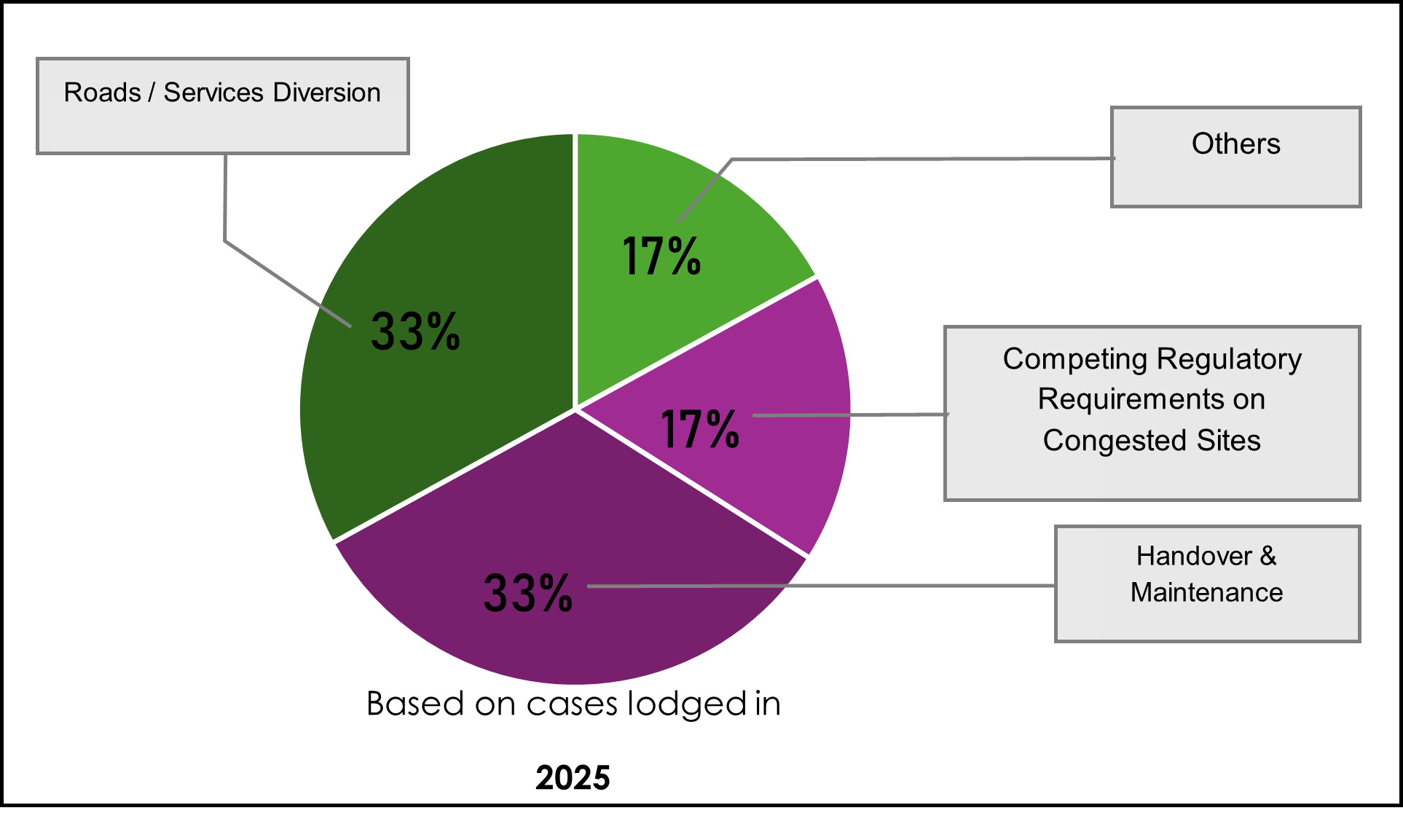
Learning points:
The exploration of various design options by QPs to comply with agencies’ requirements needs to be more thorough so as to propose feasible options for agencies to evaluate and come to decisions more expediently.
Project-level resolution
For projects with regulatory conflicts arising from technical agencies’ requirements, the Inter-Agency Coordinating Committee (IACC) is a platform to help resolve such issues.
If you encounter such issues, please fill in the attached IACC Case Lodgement Form so that we can have more details related to the project.
In addition, to enable us to better understand and appreciate the issue(s) encountered, please attach any supplementary information/drawings/documents/discussions with the relevant agencies etc. Please also indicate the outcome required, as well as your proposed alternative solution(s) after taking into account the agencies’ current responses on the matter, if applicable. Do note that the resolution process shall only commence after we have a clear picture of the case.
Please lodge the case to the IACC Secretariat via this email: BCA_IACC_SECRETARIAT@bca.gov.sg or this form: Link to IACC Case Lodgment Form.
Selected IACC Initiatives
Circular on Good Practice Guide for Wind-Driven Rain in High-Rise Residential Developments (Mar 2025)
In response to emerging challenges on wind-driven rain, a good practice Guide was developed by a joint taskforce co-led by BCA and SIA, and in close collaboration with REDAS, ACES, URA, SCDF and HDB. The Guide provides a suite of practicable passive design strategies to minimise the impact of wind-driven rain on residential developments. This guide will help building designers consider mitigation strategies and measures early in the upfront planning and design stages to minimise the need for ad-hoc downstream reactive interventions.
Inter-Agency Coordinating Committee (IACC) Circular on Serviced Apartments (Dec 2024)
On 4 December 2023, URA issued a circular on “Guidelines For Serviced Apartments II (SA2)” on 4 December 2023. SA2, also known as long-stay Serviced Apartments, is a pilot housing typology intended to provide long-term rental accommodation for Singaporeans and those coming to work or study here. In response to this new building typology and industry feedback, IACC has consolidated the requirements from the respective regulatory agencies governing Serviced Apartments II (SA2) to guide and provide industry clarity.
Inter-Agency Coordinating Committee (IACC) Circular on External Works (Dec 2024)
In early 2024, IACC and SIA formed a workgroup to study the external works requirements within congested sites in response to industry feedback on the challenges faced by project teams while trying to comply with the various competing requirements set out by technical agencies. This workgroup also involved representation from the various technical agencies including BCA, LTA, PUB, IMDA, EMA, NEA & NParks as well as trade associations and chambers including IES & ACES. The workgroup studied the structures erected at the external works of congested sites (such as bus shelter, sheltered linkways, external drains, OG boxes and roadside trees etc.) and the various technical requirements across agencies. Eight acceptable solutions were derived and agreed upon to resolve various external works scenarios.