
Alternative Cooling Technologies (ACTs)
New generation of cooling solutions that deliver energy savings while maintaining indoor comfort and enhancing operational reliability
Last updated on 17 August 2026
What are ACTs?
Alternative Cooling Technologies (ACTs) are alternative methods of cooling indoor spaces that use less electricity and have a lower environmental impact compared to conventional air-conditioning systems.
Benefits of ACTs
Significant energy savings: ACTs can achieve up to 50% energy savings over conventional ACMV system. ACTs use strategies such as higher temperature setpoints, natural airflow, radiant surfaces, or hybrid systems to deliver the same level of thermal comfort with significantly lower energy use.
More cost-effective operations: ACTs may have an initial cost premium compared to conventional ACMV systems, but they deliver significant energy savings. Commercially viable ACTs have a payback period of approximately 4 to 10 years. Certain ACTs also offer lower maintenance costs, as they do away with the need to maintain air-side equipment.
Better comfort and ventilation: ACTs reduce noise and overcooling, supporting better occupant well-being and a more stable, conducive atmosphere for work and daily activities.
ACT e-Publication

Types of ACTs in Singapore
There are several types of ACTs – the ones shown below have been deployed in Singapore:
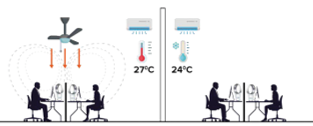
Hybrid Cooling
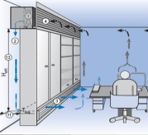
Passive Displacement Cooling
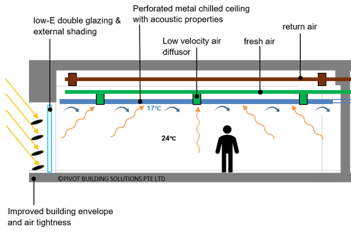
Radiant Cooling
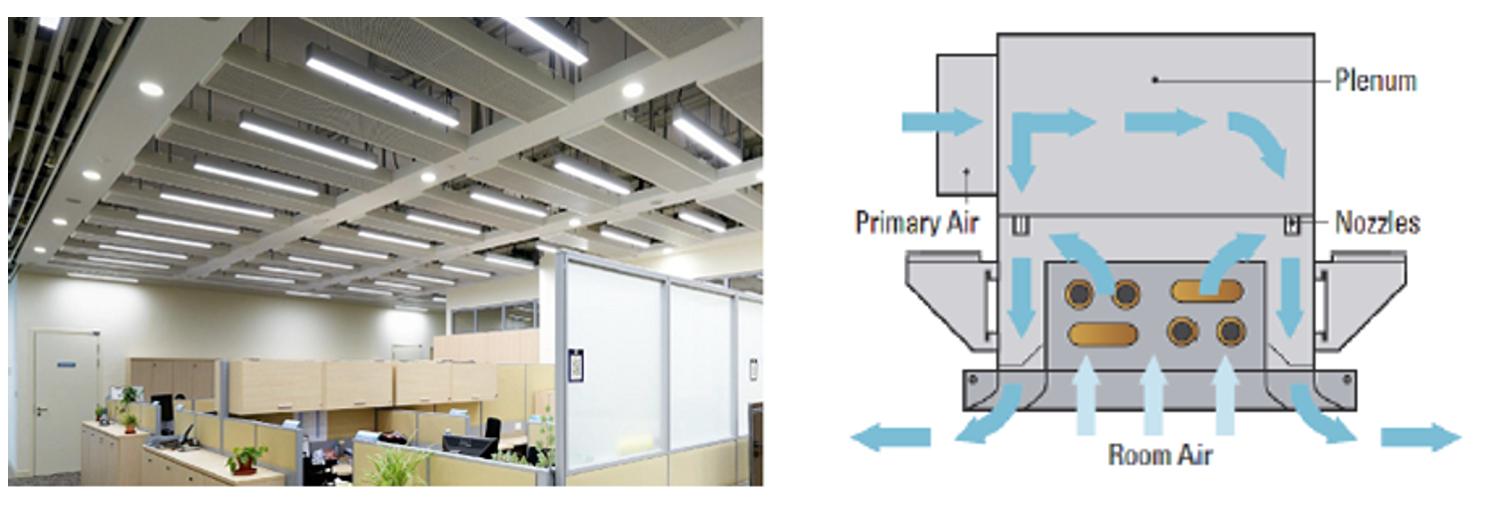
Active Chilled Beam
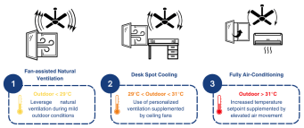
Mixed Mode Ventilation
ACTs can achieve significant cooling energy savings without compromising thermal comfort and indoor air quality.
Below is a summary of the possible use cases, energy savings and cost for the various types of ACTs.
Solutions | Possible Use Cases | New or Existing Building | Energy Saving1 (cooling system) | Cost | Payback Period |
Hybrid Cooling (HC) | Commercial (Retail, Hotel) Offices Institutional | New & Existing | 25 – 35% | $300 - $500/fan | 4 to 5.5 years |
Active Chilled Beam (ACB) | Commercial Offices Industrial | New | 20 – 50% | $450/m2 - $500/m2 | 5 to 10 years |
Passive Displacement Cooling (PDC) | Commercial Industrial Institutional | New | 40 – 50% | S$400/m2- S$700/m2 | 5 to 10 years |
Radiant Cooling (RC) | Offices | New | 25 – 35% | No commercial deployment yet Capex high, Opex low | |
Mixed Mode Ventilation (MMV) | Offices Institutional (Schools) | New & Existing | 48% | No commercial deployment yet Capex high, Opex medium | |
1The energy savings are in comparison with conventional air-conditioning system i.e. AHUs, VAV System.
ACT Directory
ACTs have been implemented across offices, campuses and other developments. Below are non-exhaustive lists of buildings which have deployed ACTs and ACT providers.
Resources
TR 141:2025 Technical Reference for Hybrid cooling system for air-conditioning
.png)
TR 102:2022 Code of practice for passive displacement cooling (PDC) system for air-conditioning application
.png)
CBE Fan Tool: Software to test fan layouts for ideal placement and parameters (for hybrid cooling)
.png)